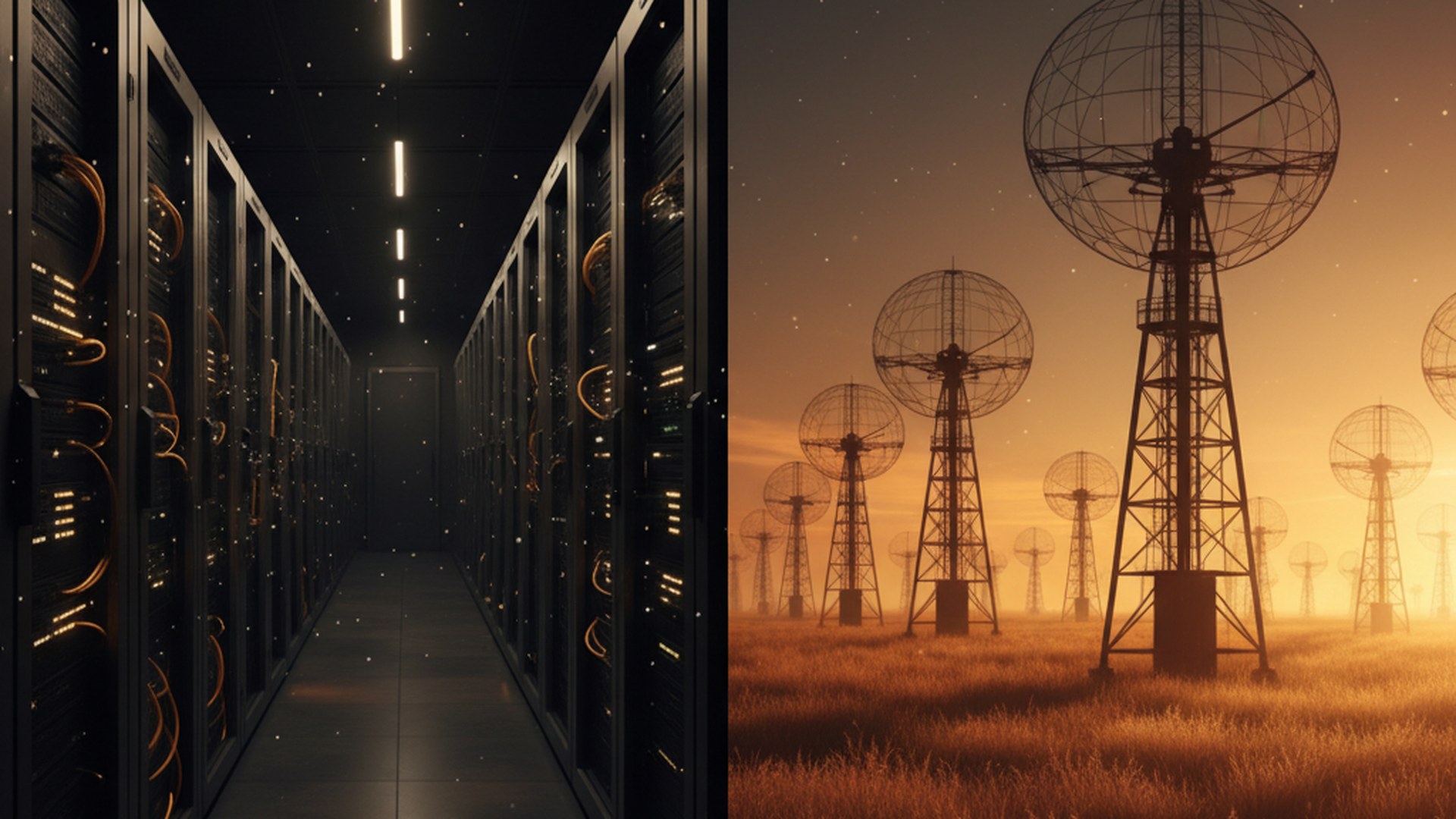
A founder I'd been tracking for six months finally got onto my calendar last Tuesday. His pitch was a decentralized wireless network, small-cell coverage for emerging-market urban density, with a hardware unit economics page I genuinely admired. Halfway through the call I caught myself comparing his numbers in my head to the latest deck from a compute-DePIN founder I'd seen a week before. I stopped mid-question and said, "I shouldn't be doing that. These aren't the same business." He laughed. He'd had the same realisation about his last LP call.
DePIN as a single sector framing made sense when the Messari DePIN report first popularised the term in late 2022. By Q2 2026 it's actively misleading. The two largest sub-sectors, decentralized compute and decentralized wireless/sensor (which I'll call "telco" as shorthand), have different unit economics, different customer profiles, different capital intensities, and different paths to credible scale. They show up under the same DePIN ticker on Messari but they're not the same investment, and the founders who pitch them as if they were are leaving money on the table.
The Two Businesses, Honestly
Compute DePIN is a software-and-orchestration business with hardware aggregation. The hardware in question is GPUs (and increasingly TPUs and CPU clusters for specific inference workloads) that already exist in the world, sitting idle for some portion of their useful life. The DePIN protocol's job is to make those idle cycles usable to a paying customer. The hardware bill of materials is somebody else's problem — gamers who bought a 4090, mid-sized data centres with utilisation gaps, sovereign computing infrastructure with off-peak windows. The protocol owns the marketplace, the scheduling, the verification, and increasingly the SLAs.
This is a software-margin business with a thin hardware-coordination layer on top. The leaders today, io.net, Aethir, Render, Akash, Bittensor's subnet stack, are not building hardware. They're building the layer that makes hardware fungible across owners. Customer-side unit economics work because the hyperscaler benchmark (AWS, GCP, Azure) prices GPU compute at a structural premium that has room for a 30–60% undercut. Supply-side unit economics work because the marginal cost of an idle GPU-hour to its owner is approximately zero, so almost any revenue is upside.
Telco DePIN, by contrast, is a hardware-and-incentives business with software orchestration on top. The hardware doesn't exist yet — the protocol's whole point is to subsidise the rollout of physical infrastructure (radios, hotspots, sensors, mapping cameras, environmental monitors) in places where the incumbent telco economics don't justify the capex. Helium, Hivemapper, DIMO, WeatherXM, the new generation of sensor networks coming out of Singapore and Tel Aviv, all hardware-first. The protocol's job is to design tokenomics that pull operators into deploying the physical infrastructure, then design the customer-side product so that the deployed infrastructure has somewhere to sell its data or capacity.
This is a capital-intensive business with software margin only at the very top of the stack. The customer-side competition is incumbent telcos, who have decades of operating experience and trillions in deployed infrastructure. The supply-side competition is the cost of capital — operators only deploy when the token-adjusted node payback period beats whatever else they could be doing with the same dollars.
Why The Difference Matters For Founders
If you're pitching compute DePIN in 2026, your wedge is cost arbitrage versus hyperscalers and orchestration quality. That's a software problem. Your roadmap is enterprise sales, customer concentration, SLA delivery, and price-discipline as the supply side expands. The capital you need is mostly working capital and engineering. The story you tell allocators is a software-margin story with a unique supply moat.
If you're pitching telco DePIN, your wedge is capex avoidance versus incumbents in a specific geography or use case, plus a regulatory tailwind where it exists. That's a hardware-deployment problem with a tokenomics-design problem layered on top. Your roadmap is operator acquisition, deployment density, customer-side product-market fit for the data you're now generating, and increasingly, this is the part most pitches miss, direct enterprise B2B contracts to anchor the network. The capital you need is real, deployed against real hardware. The story you tell allocators is an infrastructure story with a software upside on top.
The two pitches use overlapping vocabulary. The investments behind them have almost nothing in common.
Why The Difference Matters For Allocators
Here's the part I've been getting wrong, and I want to be honest about it.
For most of 2023 and 2024, I evaluated DePIN as a single category. I'd compare a compute-DePIN founder's slide deck to a telco-DePIN founder's slide deck on similar metrics, node count, network revenue, tokenomics design. Two years later I can see that I was missing the more important divergence. A compute-DePIN protocol at 10,000 active GPUs in 2025 and a telco-DePIN protocol at 10,000 active hotspots in 2025 were not in remotely the same place on their path to credible scale. The compute network was almost certainly closer to genuine product-market fit because its underlying hardware substrate already existed and its customer set was an emergent buyer of inference. The telco network was much further from product-market fit because its hardware deployment was the product, the customer set was still being defined, and the tokenomics were doing a lot of heavy lifting that real customer revenue eventually has to relieve.
I was wrong to weight them similarly. I started adjusting in late 2024. The 2025 portfolio reflects the corrected framing — we're heavier on compute-DePIN bets where the wedge is orchestration quality and customer cost arbitrage, and where we hold telco-DePIN positions we hold them with a longer time horizon and more capital reserve. The portfolio results since then suggest the adjustment was overdue rather than premature.
What's Quiet About Q2 2026
Both sub-sectors have had a quiet quarter, but for different reasons.
Compute DePIN is quiet because the leading four protocols have reached a maturity point — the customer mix has shifted toward credible off-chain AI buyers, the unit economics are working, and the narrative-driving phase is mostly done. What's happening is execution. Less Twitter, more enterprise BD. The protocols winning right now are not the ones with the loudest token marketing.
Telco DePIN is quiet because the largest networks are in the part of the curve where the deployment cost has been paid and the customer-revenue ramp is still being built. Helium has its mobile subscriber base (crossing 1M users in early 2026) but the per-user economics relative to incumbent MVNOs are still being tested. Hivemapper has its imagery network but the autonomous-vehicle and logistics-side enterprise contracts are mid-conversation. WeatherXM has the regulatory tailwind I described in Field Notes #1 but the deployment is staged over a longer timeline than the token market initially priced.
In both cases, the quiet is healthy. Loud quarters in DePIN have historically been correlated with token-cycle dynamics rather than business-fundamental dynamics. The quiet quarter is the one where the businesses do real work.
What I'd Actually Underwrite Now
For compute DePIN, the bets I'd make in 2026 are on the layer above the four-protocol race. Orchestration-quality protocols. Verification and proof-of-inference layers. Specialised compute aggregators for specific workloads (zkML, on-chain agent inference, fine-tuning-as-a-service). The base-layer race is mostly settled. The application and tooling layer is open.
For telco DePIN, the bets I'd make are on networks with credible enterprise B2B anchor customers from the start, not just token-incentivised retail operators. The sensor-network founder I mentioned in Field Notes #1, the one with signed memoranda from SEA environmental agencies, is the shape of bet that I think works in 2026. A network that has a customer before it has a token is a different animal from one that has a token first.
The Forbes-Quotable Line
If I had to compress this to one sentence: DePIN isn't a sector — it's two sectors with overlapping vocabulary and nothing else in common, and the founders and allocators who internalise the split are the ones positioned to win 2026.
The next Field Notes will be a specific conversation from this week with two decentralized-AI founders that left me with a question neither could answer. If you're in either side of the DePIN split and the framings here don't match what you're seeing, push back: LinkedIn or Telegram.